A tactical decision game — a TDG, or tactical decision exercise — is one situation, one hard problem and a short clock. You read the situation once, you decide, and you deliver the decision out loud as an order. There is no solution printed at the bottom of the page, because the point is not to be right. The point is to be fast, clear and able to say why.
This is the first of a series. Each scenario ships with the overlay as a picture and as an editable TacMap scene, so you can run it on a screen, project it, or print it for the table.
The situation
You are the squad leader of Alpha Squad, 2nd Platoon, 3rd Battalion. The unit is deployed in an arid river valley on counter-insurgency operations. The local militia is armed with automatic rifles, light machine guns, and occasional mortars and RPGs.
Today your platoon — reinforced by an attached medium machine gun team — is conducting a route clearance and security patrol to locate and destroy hostile forces in the area. Twilight is roughly thirty minutes away.
Your squad is the point element. You are advancing north inside a knee-deep, muddy irrigation canal, about 200 metres ahead of the platoon's main body.
- East of you: a concrete aqueduct wall about a metre high, running north–south parallel to your line of march, some thirty metres to your right. Beyond it are open alfalfa fields and a scatter of livestock shelters.
- West of you: an abandoned industrial farm compound of mud-brick walls and outbuildings, about 200 metres away across open ground, with higher ground rising behind it.
- Underfoot: the embankments and the tracks are seeded with anti-personnel pressure-plate IEDs and are strictly out of bounds. Wading the canal is brutal, but it is the safe route. That restriction applies to everybody, including the platoon behind you.
As your lead fireteam steps across an intersecting dirt track at the northern edge of the canal, a concealed tripwire IED detonates. Your lead rifleman takes a severe traumatic leg injury.
Immediately after the detonation, enemy forces inside the western farm compound open heavy, sustained automatic fire. The platoon leader is hit and down.
The volume of fire from the compound has Bravo and Charlie Squads pinned flat in the open. The platoon medic low-crawls forward to your canal position under fire, followed shortly by the attached machine gun team. The medic reports that the lieutenant is critically wounded and unconscious. The platoon radio operator is pinned in the open near the lieutenant, which leaves you without communications.
The fire coming into your canal position is sporadic. Bravo and Charlie are locked in and cannot manoeuvre, although they are returning fire. You have no contact with your platoon sergeant.
The sun drops below the horizon in less than thirty minutes.
What do you do?
The requirement
Within five minutes:
- 1. Draft the fragmentary order (FRAGO) you will issue to your team leaders.
- 2. Outline the additional immediate actions you will execute.
- 3. Give a brief description of your overlay sketch.
- 4. Explain the tactical rationale behind your decisions.
Reading the overlay
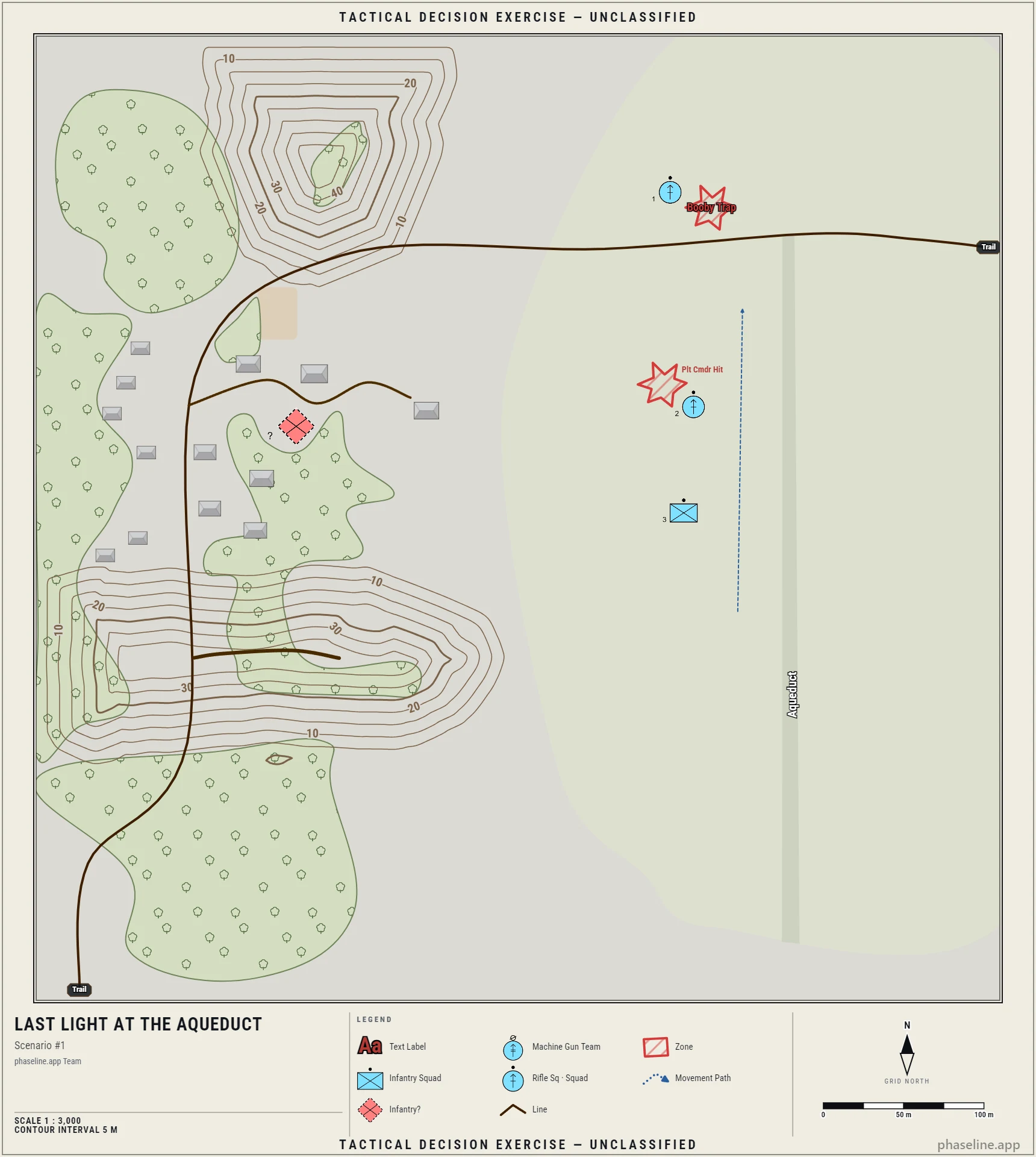
The picture is drawn to the same standard the platoon would use for a hasty overlay, and it is worth reading properly before you start the clock.
- Scale and relief. 1:3,000, contour interval 5 m. The compound sits low; the ground behind it climbs to 30–40 m. That matters for anything you intend to do with the machine gun, and for what the enemy can see of you.
- Your units. Alpha (1) at the northern edge of the canal, the platoon main body with the platoon leader (2) some 200 m south, Charlie (3) behind that. The dashed arrow is the route you came up.
- The enemy. One suspected infantry element inside the compound, marked with a question mark. Strength, exact positions and the number of firing points are unknown. The map does not tell you, and neither does the situation — because you do not know.
- What is deliberately missing. No enemy weapon positions, no casualty collection point, no support-by-fire position, no route out. Those are yours to draw.
What makes this one hard
Name the tensions before you start writing, because the order you resolve them in is your decision:
- A casualty who needs treatment now, and a volume of fire that makes treating him where he lies expensive.
- A command vacuum. The platoon leader is down, the radio operator is pinned, the platoon sergeant is unreachable. Somebody has to act, and you are the only leader with a squad that is not pinned. What you still have is the purpose of the platoon's task: commander's intent is written for exactly this moment.
- The only element that can change the fire fight — the machine gun team — has just arrived at your position, and the ground that would let it shoot is the ground you are forbidden to walk on.
- Thirty minutes of daylight. Darkness helps you break contact and hurts everything that needs to be coordinated by sight, including casualty evacuation and any linkup.
- Two friendly squads in the open, in a crossfire, whose situation gets worse the longer the enemy fires unanswered.
You will not solve all five. Decide which two matter in the next ten minutes, and be able to say why the other three can wait.
Run it, then run it again in a month with the same group. The second set of answers is the one that tells you whether anything stuck.