Every order contains a plan, and every plan is wrong within minutes of contact. The bridge is down, the enemy is somewhere else, the radio is dead. The part of the order that still works at that moment is the commander's intent. It is the only part written for the situation nobody predicted.
US Army doctrine (ADP 6-0, Mission Command) defines it as "a clear and concise expression of the purpose of the operation and the desired military end state that supports mission command, provides focus to the staff, and helps subordinate and supporting commanders act to achieve the commander's desired results without further orders, even when the operation does not unfold as planned."
The last clause is the point. The intent does not exist to make the order complete. It exists so that a subordinate who has lost the plan can still act, correctly, without asking.
What goes into it
The two US services break the intent into three parts. The labels differ slightly, and the difference is instructive.
| US Army | US Marine Corps | |
|---|---|---|
| Why | Purpose — the broader reason for the operation | Purpose |
| What must be true on the way | Key tasks — what the force as a whole must do | Method — how the commander sees the decision being achieved, in broad terms |
| What done looks like | End state — the conditions at the end, in terms of enemy, terrain, own forces and civilians | End state |
The Army's definition of key tasks carries a warning: they are the activities the force as a whole must perform to reach the end state, and they are not specified tasks for any subordinate unit. A key task is "control the road junction" or "keep the enemy reserve north of the stream". It is not "Alpha team moves to the tree line". The moment the intent starts to assign work to named units, it has become the concept of operations — a different paragraph of the order, with a different job.
Purpose is the part that does the work
Marine Corps doctrine (MCDP 1, Warfighting) puts it in one line: there are two parts to any mission, the task and its purpose, and of the two, the purpose is more important. The task says what to do. The purpose says why, and the why is what survives when the task no longer fits the ground.
This is the idea the Prussian army built into Auftragstaktik: tell subordinates what you want to achieve and why, and let them find the how. It only works if the why is stated clearly enough to decide on.
The picture below is a small example of it.
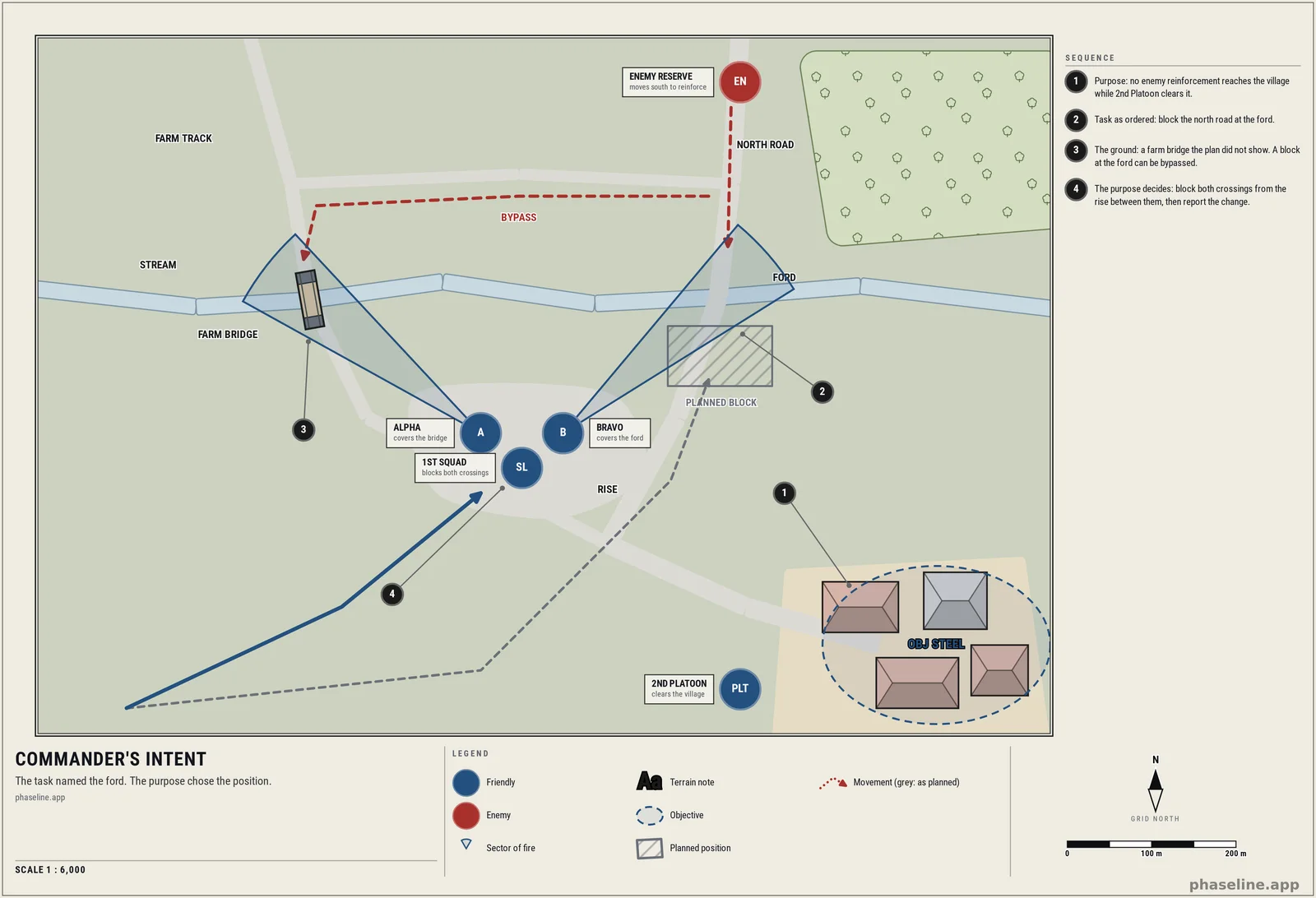
The order said: block the north road at the ford, in order to prevent enemy reinforcement of the village while 2nd Platoon clears it. On the ground, 1st Squad finds a farm bridge five hundred metres west of the ford. The map did not show it. A block at the ford now does exactly what the task says and nothing of what the purpose needs: the enemy reserve drives around it.
A squad leader who knows only the task sits at the ford and reports success while the village is reinforced. A squad leader who knows the purpose sees that the ford was never the point. The squad goes to the low rise between the two crossings, puts a team on each, and uses the stream as the obstacle it still is. Then the squad leader tells the platoon leader, at once, what changed and why. Initiative inside the intent is not permission to go quiet.
How to phrase it
The intent is short, written by the commander, and read under stress. Some rules that follow from that:
- Write it yourself. Field Marshal Slim said of the intention paragraph in Defeat into Victory that it should be worded by the commander personally, because everything else in the order is subordinate to it. A staff can draft the concept of operations. The intent is the commander's own will.
- Lead with the purpose, and make it one level wider than the task. "Seize the bridge" is a task. "So that the company can cross before the enemy reserve arrives" is the purpose. A purpose that only restates the task ("in order to secure the bridge") tells the subordinate nothing new.
- Key tasks describe effects, not assignments. Terrain the force must hold, an effect it must have on the enemy, a condition it must keep. If a unit name appears in a key task, move the sentence to the concept of operations.
- Describe the end state as a picture a subordinate can check. Where the enemy is and what it can still do. Which ground is ours. Where our own elements are and what they are ready to do next. "Mission accomplished" is not an end state.
- Leave out the how. Routes, formations, timings and phase lines belong in the scheme of maneuver and on the map. The intent must still make sense when every one of them has failed.
- Use doctrinal terms. Block, fix, seize and secure mean specific things. Precise words let a short intent carry a lot.
- Keep it short enough to remember. If the squad cannot say it back after the briefing, it is too long for the moment it is needed.
A bad intent and a better one
Bad: "1st Squad will move along the south track, arrive at the ford by 0600 and establish a blocking position with Alpha on the left and Bravo on the right. Hold until relieved."
That is a plan with no purpose. Every sentence of it fails the moment the ground differs from the map.
Better:
- Purpose: No enemy reinforcement reaches the village while 2nd Platoon clears it.
- Key tasks: Deny the crossings of the stream to the enemy reserve. Report enemy movement on the north road early.
- End state: No enemy element south of the stream. 1st Squad in position with contact to the platoon, ready to rejoin it for consolidation.
The second version says nothing about the ford, and that is why it still works when the farm bridge turns up.
Nest it two levels up
An intent does not stand alone. ADP 6-0 says each commander's intent nests within the commander's intent two levels up, and the order format carries both: the friendly-forces part of paragraph 1 gives the mission and intent of the next two higher echelons, and the unit's own intent opens paragraph 3.
For a squad leader that means knowing why the platoon is doing what it does, and why the company needs it. In the example, the squad's purpose is the platoon's task seen from below: the platoon clears the village, and the squad keeps the village clearable. That link is what let the squad leader move away from the ford without guessing.
A quick test when you write your own: read the intent one level up, then yours. If yours does not visibly serve it, one of the two is wrong.
Test it on the sand table
The only way to know whether an intent is usable is to break the plan and see what people do with it.
- Backbrief it. After the order, each subordinate leader repeats the intent in their own words. If the purpose comes back as a task, it was not clear.
- Change the ground. On the sand table or in a tactical decision game, remove a bridge, add a crossing, move the enemy. Ask each leader what they do now and which part of the intent told them. For a ready-made case, run Last Light at the Aqueduct: the platoon leader is down, the radio is out of reach, and a squad leader has only the intent left.
- Put it on the map. Write the intent in a callout box on the briefing map, beside the objective. People look at the map during the rehearsal far more than at the order.
The scene behind the picture above is editable. Open it, move the farm bridge, add a third crossing, and ask your squad leaders where they would set up. If every answer is different and all of them serve the purpose, the intent is doing its job.