Ask a squad leader what went wrong on the last operation and you will rarely hear "I didn't know the tactics." You will hear that the decision came too late, or that it was made and never transmitted, or that three people heard three different versions of it. The knowledge was there. What failed was the act of deciding under time pressure and making the decision travel.
That is a separate skill from knowing doctrine, and it is trainable. The cheapest tool for training it is a tactical decision game — a TDG. One situation, one hard problem, a short clock, and an order you have to say out loud. No terrain, no troops, no server, no live-fire budget. One picture and twenty minutes.
What a TDG actually is
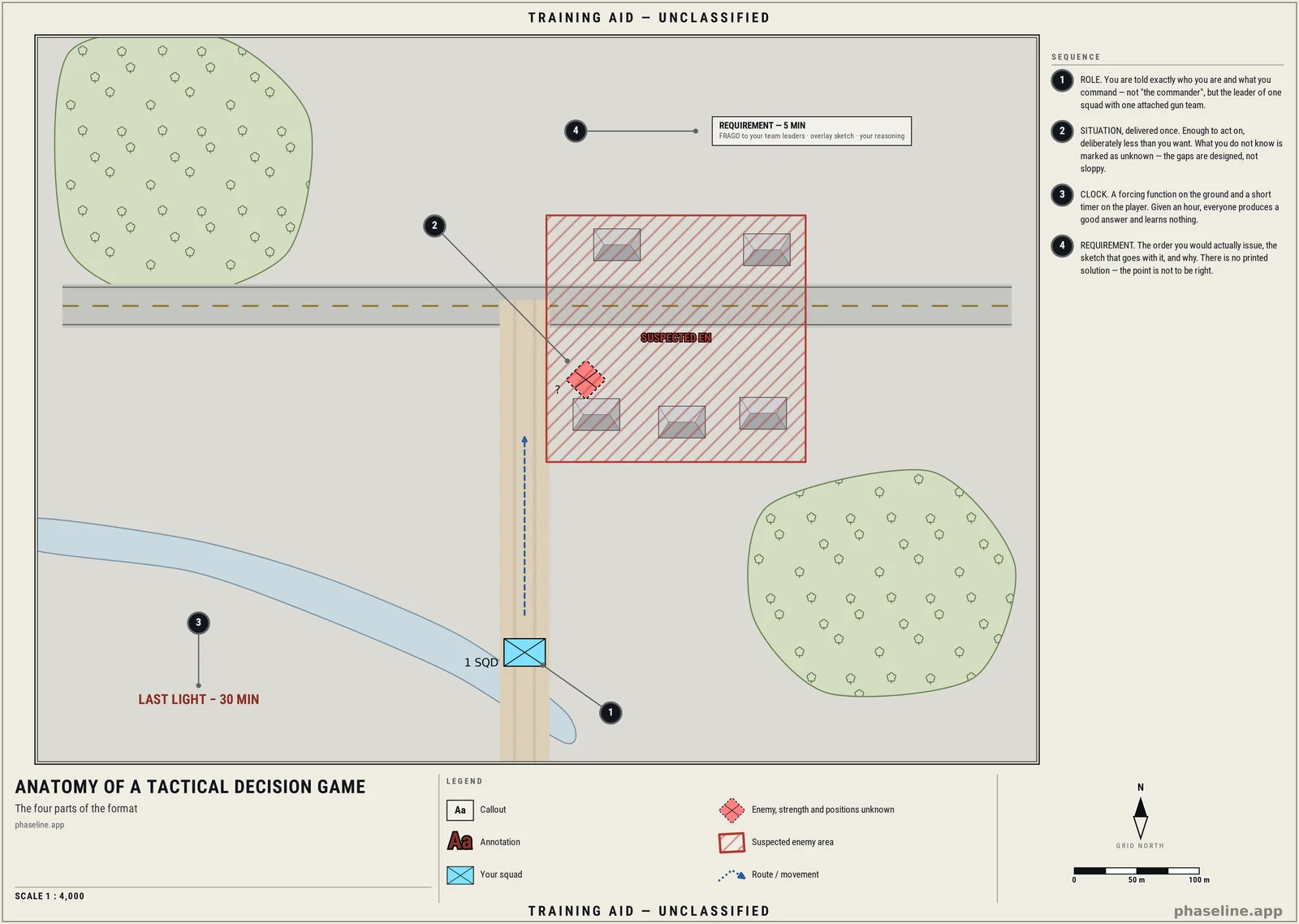
A TDG is not a quiz and not a scenario in the wargame sense. It has four parts, and dropping any one of them turns it back into a discussion.
- A role. You are told exactly who you are and what you command. Not "the commander" — you are the squad leader of Alpha, your platoon leader is down, you have an attached gun team.
- A situation, delivered once. Enough to act on, deliberately less than you want. What the enemy is doing is partly unknown, because it always is.
- A clock. Typically five minutes for a squad-level problem. The clock is not decoration; it is the entire experimental condition. Given an hour, everyone produces a good answer and learns nothing.
- A requirement. Usually: issue the fragmentary order you would give your team leaders, sketch your overlay, and state your rationale.
And one thing it deliberately does not have: a printed solution. There is no answer key, because the objective is not to be right. It is to be fast, to be clear, and to be able to say why.
Where they come from
The format is not new and it is not improvised. It is a compressed version of the Prussian applicatory method — teaching by making the student apply doctrine to a concrete situation rather than recite it.
Helmuth von Moltke, chief of the Prussian General Staff from 1857 to 1888, set his officers what he called taktische Aufgaben — tactical assignments. The construction is worth noting, because it is exactly what this site publishes: fictional units placed on real terrain. The collection was printed in 1892 as Moltkes taktische Aufgaben aus den Jahren 1858 bis 1882, and translated two years later as Moltke's Tactical Problems. Julius von Verdy du Vernois named the method in the title of his 1876 Kriegsgeschichtliche Studien nach der applikatorischen Methode, which took real battles — Custozza, 1866 — and re-fought them with different formations to see what else the ground would have permitted.
Verdy is also the man who broke Kriegsspiel open. The Prussian wargame had accumulated dice, casualty tables and a rulebook thick enough to need a specialist; his contribution was to throw them out and hand adjudication to an umpire, who ruled on where the tactical advantage lay. That is the decision the whole tradition keeps making, in every era: the value is in the experience of deciding, not in the fidelity of the model or in who wins.
The chain into the present is short:
- 1904 — The Defence of Duffer's Drift. Ernest Swinton, writing as "Lieutenant Backsight Forethought", gives one officer fifty men and one river ford, and has him defend it six times over in six dreams, each attempt fixing the previous night's disaster. It is the ancestor of run it again, not of no school solution — Duffer's Drift very much has answers. Still the best single evening of reading on this list, and still issued at infantry schools.
- 1975 — What Now, Lieutenant? The 9th Infantry Division's Simulation Center at Fort Lewis publishes a training package of battalion, company and platoon situations for junior leaders. The modern format, in its recognisable shape.
- 1982 — the Marine Corps Education Center builds three instructional pamphlets on that foundation — twelve of the existing problems plus sixteen new ones written by Chief Warrant Officer Bryan N. Lavender.
- April 1990 — the Marine Corps Gazette starts running a tactical decision game in every issue, publishing readers' competing solutions three months later — competing, note, not correct. It still does.
- 1994 — the Marine Corps Association collects fifteen of them, with commentary, as John F. Schmitt's Mastering Tactics: A Tactical Decision Game Workbook. Schmitt is the officer who drafted FMFM 1 Warfighting, and that is not a coincidence: a doctrine built on decentralised decision under uncertainty needs a training device that rehearses exactly that.
A hundred and sixty years of soldiers have converged on the same austere thing — a situation, a map, a clock, and an argument afterwards — while every richer and more expensive method has come and gone around it.
The other survivors are worth knowing, because they trade cost against fidelity:
- The TDG — a picture and a clock. Minutes to run, minutes to prepare.
- The sand table exercise — the same problem made physical, with the terrain modelled and the pieces moved.
- The TEWT (tactical exercise without troops) — leaders on the actual ground, no soldiers, walking the problem.
- The staff ride — a historical engagement, on the ground where it happened.
The TDG sits at the cheap end on purpose. That is its advantage, not its compromise: it is the only one of the four you can run every week.
Why it works
The mechanism is well documented outside the military. Gary Klein's research on fireground commanders — twenty-six of them, averaging over twenty years' experience — found that they did not generate options and compare them. In roughly 80% of the decisions studied, the commander recognised the situation as an instance of a pattern he had seen before, retrieved the typical response, mentally simulated it to check it would work, and acted. He considered exactly one course of action. That is the recognition-primed decision model, and Klein set it out in Sources of Power in 1998.
The consequence for training is direct. If expertise under time pressure is a library of recognised patterns, then the way to build it is volume of exposure to varied situations, not more theory about any one of them. A leader who has worked through forty tactical problems has forty prototypes to recognise. A leader who has read forty pages about the flanking attack has one.
TDGs are how you buy those reps at a price you can actually pay. A field exercise gives your squad leader one or two decision points in a day. A stack of TDGs gives them ten in an evening.
Running one, in twenty minutes
The loop is short enough to run in a briefing room, a Discord voice channel, or the back of a truck.
- 1. Brief — 2 minutes. Read the situation aloud once while the overlay is on screen or on the table. Once. Re-reading it on request quietly teaches that information will be repeated until understood, which is the opposite of the lesson.
- 2. Decide — 5 minutes. Silent, individual, written. Not a group discussion. Everybody has to produce their own decision, or the confident voice in the room produces it for everyone.
- 3. Deliver — 2 minutes each. The player says the order out loud to notional subordinates, in whatever order format your unit uses. This is the step people cut, and cutting it removes half the value: a decision that cannot be transmitted in ninety seconds has not actually been made.
- 4. Discuss — 10 minutes. Compare two or three different decisions.
Four facilitation rules make the difference between training and a chat:
- Attack the reasoning, never the choice. "Why did the gun go there?" is the whole exercise. "That's wrong" ends it. Two players who chose opposite courses can both have been right, and the discussion is about which assumptions each was betting on.
- Refuse the fantasy asset. "I'd call in air" and "my machine gunner suppresses them" are not decisions. If it is not in the situation, it does not exist; if it is, say who does it, from where, and when.
- Enforce 70%. A decision that is 70% right and issued now beats a perfect one issued after the enemy has moved. Reward the player who committed and was partly wrong over the one who was still weighing options when the clock stopped.
- Run it again in a month. The second set of answers, from the same group on the same problem, is the only honest measure of whether anything stuck.
Scale the problem to the chair
A TDG trains one specific person. Handing a fire team leader a problem that requires committing the platoon's reserve trains nobody — they will answer as a platoon commander, which is not the job they will be doing on Saturday.
- Fire team leader. One building, one street, one casualty, four people and what they are carrying. The decision is where the team goes in the next sixty seconds and who covers what. Two-minute clock.
- Squad leader. Two or three manoeuvre elements plus something attached, a piece of ground, and a problem that forces a choice between two of them. Five minutes. This is the classic TDG scale and where most published problems sit.
- Platoon or company commander. Time, sequencing and resources, not just ground: which task gets the support element, what happens at last light, what you report and to whom. Ten minutes, and the requirement should include the report up as well as the order down.
The most useful thing a unit can do is run the same map at all three scales on the same evening. The FTL's sixty seconds and the commander's timeline are the same event seen from different chairs, and hearing the other two chairs argue is where junior leaders learn what their orders sounded like from below.
For the leader who trains offline
If you run a cadet detachment, a reserve section, a reenactment group, or an airsoft or milsim team that meets in person, the TDG solves a scheduling problem you already have. Leadership repetitions normally cost you a full turnout: terrain, transport, everyone present, weather. A TDG costs one printed overlay and the twenty minutes you were going to spend on admin anyway.
Concretely, the slots that work:
- The twenty minutes before a training day, using the ground you are about to walk onto.
- The debrief slot after it — re-run the day's actual contact as a TDG, with the real decision point turned into the problem.
- A sand table night when the weather kills the field plan. The overlay projects, or prints at A3 and lives on the table.
The same argument applies to anyone else who owns a decision under time pressure with incomplete information: fire and rescue crews, mountain rescue and SAR teams, ski patrol, event and site security. Klein's original subjects were firefighters, not soldiers. Swap the situation, keep the four parts.
For the leader who trains online
If you lead a squad in an Arma, Reforger, Squad or Hell Let Loose unit, your problem is sharper still. Every leadership repetition currently costs you a full server: forty people, a scheduled operation night, and one squad leader who gets to practise while the other thirty-nine wait on him. That is an expensive way to find out that your new FTL freezes when the plan breaks.
A TDG needs one image and a voice channel. That changes what you can train and when:
- Off-night leadership training. Six players, a Discord voice channel, one overlay posted in the chat, forty minutes. No mods to update, no server to reserve, nobody has to install anything.
- Rehearse the format, not just the tactics. Most online units have a briefing and radio format on paper that nobody has ever practised at speed. The delivery step is where a squad leader learns to produce a FRAGO in ninety seconds — so that on operation night they are executing a format rather than inventing one under fire.
- Screen and develop FTLs. Promoting people to fire team leader on the basis of attendance is how most units do it. A short TDG shows you, in five minutes, whether a candidate can commit to a decision and explain it — before you find out live.
- Debrief your own operations. The strongest scenarios your unit will ever run are the ones that already happened to it. Take the moment last Saturday where the plan came apart, freeze it, strip the outcome, and issue it as a problem.
The requirement should be answered the way it would be transmitted: on voice, to the net, in your unit's order format. Typing the answer in chat trains the wrong muscle.
Writing your own
A good TDG is a dilemma, not a puzzle. A puzzle has a solution you have hidden; the player's job is to guess what you were thinking. A dilemma has two or three defensible courses that cannot all be taken, and the player's job is to choose and own it. If you can write down the right answer while designing the problem, you have written a puzzle — put another force on the board until you can't.
Four things to build in deliberately:
- A genuine conflict of goods. A casualty who needs evacuating now and an enemy position that will get worse if left alone. Not a threat and its obvious counter.
- Designed ignorance. Decide what the player does not know and mark it as unknown on the overlay. A question mark on an enemy marker is a teaching device, not laziness.
- A forcing function. Last light, a fuel state, a timed linkup, a casualty's clock. Something that makes "wait and gather more information" an expensive choice rather than a free one.
- Ground that constrains. The reason the map matters. A canal you must wade because the banks are mined, a ridge that owns the only firing position, a single crossing. Terrain that permits everything teaches nothing.
The series
We publish these as tactical decision games on this site, one situation at a time. Each one ships with the overlay as a picture and as an editable Phaseline scene, so you can project it, print it for the table, or open it and change it into your own problem.
The scenes carry two phases: Initial Situation, which is what the players see, and a blank second phase where the player draws their own solution — the overlay sketch the requirement asks for, on the same ground, with the same tools.
Start with Last Light at the Aqueduct. Run it with your team leaders this week. Then open the scene, move the enemy, and hand them a problem they have never seen.
Sources
- Moltkes taktische Aufgaben aus den Jahren 1858 bis 1882, 1892; English edition Moltke's Tactical Problems from 1858 to 1882, 1894.
- Julius von Verdy du Vernois, Kriegsgeschichtliche Studien nach der applikatorischen Methode, 1876; and Beitrag zum Kriegsspiel, 1876, which replaced the Kriegsspiel rulebook with an umpire.
- Ernest Dunlop Swinton, The Defence of Duffer's Drift, 1904; reprinted in the Journal of the United States Infantry Association, April 1905, and freely available from the US Army Infantry School.
- What Now, Lieutenant?, Simulation Center, 9th Infantry Division, Fort Lewis, 1975.
- John F. Schmitt, Mastering Tactics: A Tactical Decision Game Workbook, Marine Corps Association, 1994.
- Gary Klein, Sources of Power: How People Make Decisions, MIT Press, 1998.
- Klein, Calderwood and Clinton-Cirocco, "Rapid Decision Making on the Fire Ground" (original 1986 study, republished with postscript in Journal of Cognitive Engineering and Decision Making, 2010).
- The Marine Corps Gazette TDG series, running since April 1990; the Marine Corps Association's TDG Arena carries the current problems.